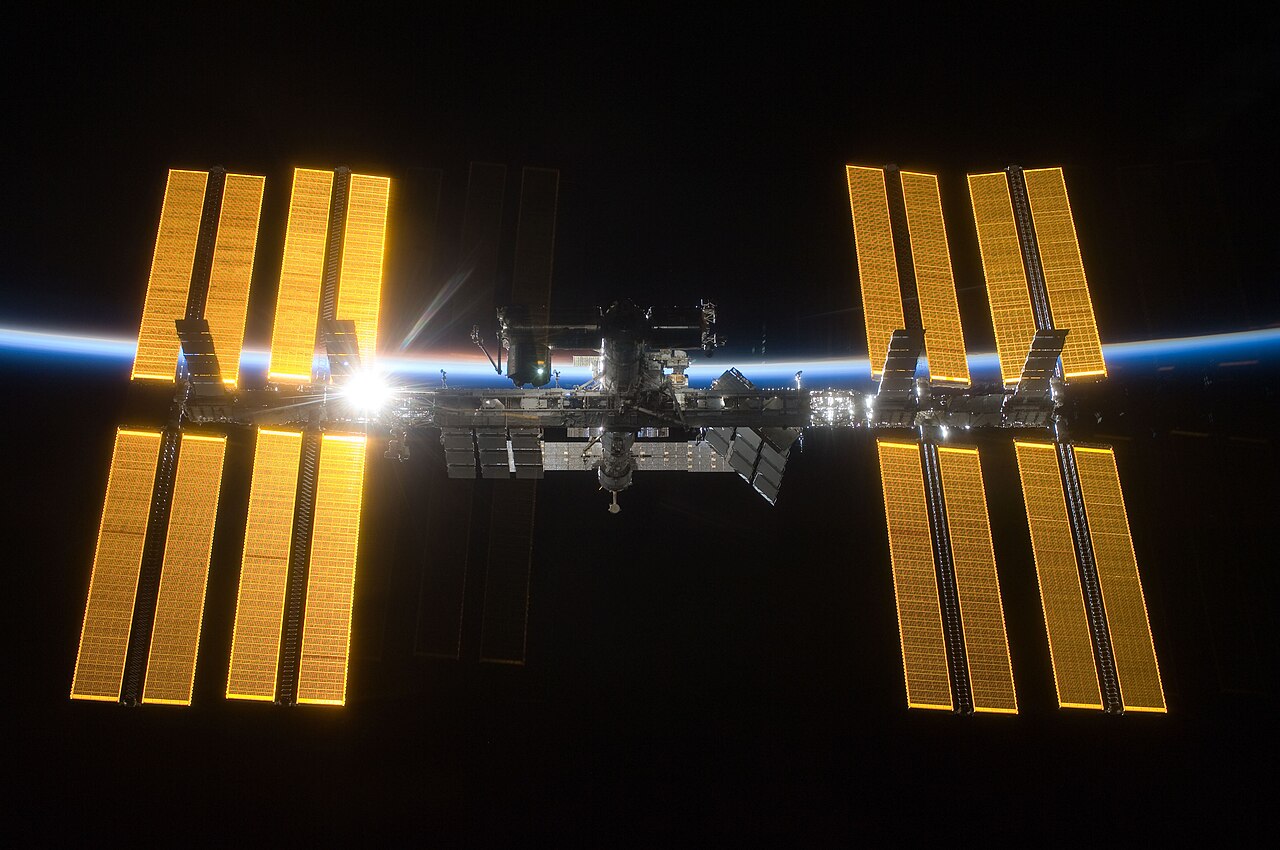
International Space Station after STS-119, March 2009. Photo: NASA, via Wikimedia Commons (public domain)
Quick Answer: Houston-based Axiom Space signed a memorandum of understanding in November 2026 with Wichita, Kansas-based Nitride Global Inc. to grow aluminum nitride semiconductor crystals in microgravity. The deal extends a NASA-funded research project and is part of Axiom’s push to make in-space manufacturing a commercial business.
Axiom Space has added another partner to its plan to turn orbit into a factory floor. The Houston company and Nitride Global Inc. signed a memorandum of understanding (MOU) earlier this month to work together on growing next-generation semiconductor crystals in microgravity, according to a company news release reported by InnovationMap.
The focus is aluminum nitride, a material that is hard to grow well on Earth but is drawing interest for high-voltage electronics. The agreement builds on work the two companies already do with NASA Ames Research Center.
What did Axiom Space and Nitride Global agree to?
The MOU sets up a partnership to produce aluminum nitride (AlN) crystals in low-Earth orbit. Nitride Global brings its AlN crystal growth and advanced packaging know-how. Axiom brings orbital infrastructure and mission integration.
Lucie Low, chief science officer for Axiom Space, said in the release that the signing reflects growing commercial interest in making advanced semiconductor materials in space, and that the pairing positions the companies to show real commercial value in low-Earth orbit.
Mahyar Khosravi, CEO of Nitride Global, called the MOU a milestone in a partnership that began under a NASA Small Business Innovation Research (SBIR) project for AlN growth in space. He said the goal is a platform for commercially viable manufacturing of ultrawide bandgap materials for semiconductors and microelectronics, for use both on Earth and in planetary exploration.
| Item | Detail |
|---|---|
| Agreement type | Memorandum of understanding |
| Signed | Early November 2026 |
| Texas partner | Axiom Space, Houston |
| Other partner | Nitride Global Inc., Wichita, Kansas |
| Material | Aluminum nitride (AlN) single crystals |
| Where | Low-Earth orbit, in microgravity |
| Builds on | NASA SBIR work and collaboration with NASA Ames Research Center |
Why grow aluminum nitride crystals in space?
Aluminum nitride is one of the newer ultrawide bandgap semiconductor materials. It is essential to emerging high-voltage transistors and is also used in some medical technologies. Its high thermal stability lets it work in harsh settings, which is why the material is tied to applications from electric vehicles to the power grids that charge them.
The catch is production. On Earth, AlN crystals face defects and size limits caused by gravity. According to Nitride Global, microgravity lets the crystals grow more uniformly and with fewer defects, which could yield larger, purer and more reliable crystals.
How is this different from making chips in orbit?
The plan is not to build finished computer chips in space. It is to grow the base crystal material, the starting point for devices that are then made on the ground. That is a narrower target, and one where the physical advantage of weightlessness is easier to explain.
What NASA work does the MOU build on?
In February 2026, Semiconductor Today reported that Nitride Global, United Semiconductors LLC (USLLC) of Los Alamitos, California, and Axiom Space had been awarded a NASA SBIR grant. USLLC has supplied substrates to the U.S. defense sector and national laboratories since 2005.
The project is titled “Physical Vapor Deposition Reactor Design and Validation for In-Space Manufacturing of Aluminum Nitride Single Crystals” and was described as Phase II.
| Phase | Lead or Partners | Goal or Result |
|---|---|---|
| Phase I | Led by USLLC | Proof-of-concept reactor reaching 2,800 to 3,200 degrees Celsius, using 250 to 400 watts and weighing under 700 grams |
| Phase II | Nitride Global, USLLC, Axiom Space | Flight-ready prototype for the International Space Station, sized to mid-deck locker rules, with NASA safety review and payload integration approval |
| MOU (Nov. 2026) | Axiom Space, Nitride Global | Path toward commercial production of AlN crystals in low-Earth orbit |
The reported dollar amount of the grant and its contract period were not stated.
How does this fit Axiom’s in-space manufacturing strategy?
Axiom is developing Axiom Station, which it describes as the successor to the International Space Station, where research and manufacturing can be carried out. The Nitride Global deal is not the company’s first semiconductor agreement.
What other semiconductor partners does Axiom have?
On Oct. 1, 2025, at the International Astronautical Congress in Sydney, Axiom signed an MOU with Resonac Corporation, a Japanese functional chemicals company that makes semiconductor materials. That agreement covers research, development and manufacturing of semiconductor materials in microgravity and the vacuum of low-Earth orbit, including bulk crystals, resins and 2D materials for chip and packaging uses. The partners plan to use the ISS, Axiom’s orbital platforms and the future Axiom Station. Resonac is also extending existing work with Axiom on molding compounds meant to reduce soft errors caused by space radiation.
| Partner | Date | Focus |
|---|---|---|
| Resonac Corporation (Japan) | Oct. 1, 2025 | Bulk crystals, resins, 2D materials, radiation-resistant molding compounds |
| Nitride Global and USLLC (NASA SBIR) | Feb. 2026 report | In-space reactor for AlN single crystals |
| Nitride Global | Nov. 2026 | Commercial AlN crystal growth in orbit |
What does this mean for Texas business?
For the Houston area, the deal adds to a pattern: an out-of-state technology company choosing a Texas space firm as its route to orbit. Each new MOU gives Axiom another potential paying customer for orbital research and production capacity. It also links Houston’s space sector to semiconductors, an industry Texas has backed with its own state grant fund.
An MOU is a statement of intent, not a binding production contract, so the next markers to watch are the Phase II reactor’s flight readiness and any agreement that sets out flights, volumes or pricing.
Frequently Asked Questions
What did Axiom Space announce?
A memorandum of understanding with Nitride Global Inc. to grow aluminum nitride semiconductor crystals in microgravity.
Where are the companies based?
Axiom Space is based in Houston. Nitride Global is based in Wichita, Kansas.
Why use microgravity?
Gravity causes defects and size limits when AlN crystals grow on Earth. In microgravity, crystals can grow more uniformly with fewer defects.
Is NASA involved?
The partnership grew out of a NASA SBIR project, and it builds on collaboration with NASA Ames Research Center.
What is Axiom Station?
A commercial station Axiom is developing as a successor to the International Space Station for research and manufacturing.
Sources and Further Reading
- Axiom Space inks partnership to grow semiconductor crystals in orbit, InnovationMap
- Nitride Global, USLLC and Axiom Space awarded NASA SBIR grant, Semiconductor Today
- Axiom Space and Resonac Sign MOU to Advance Space-Based Semiconductor Manufacturing, Axiom Space