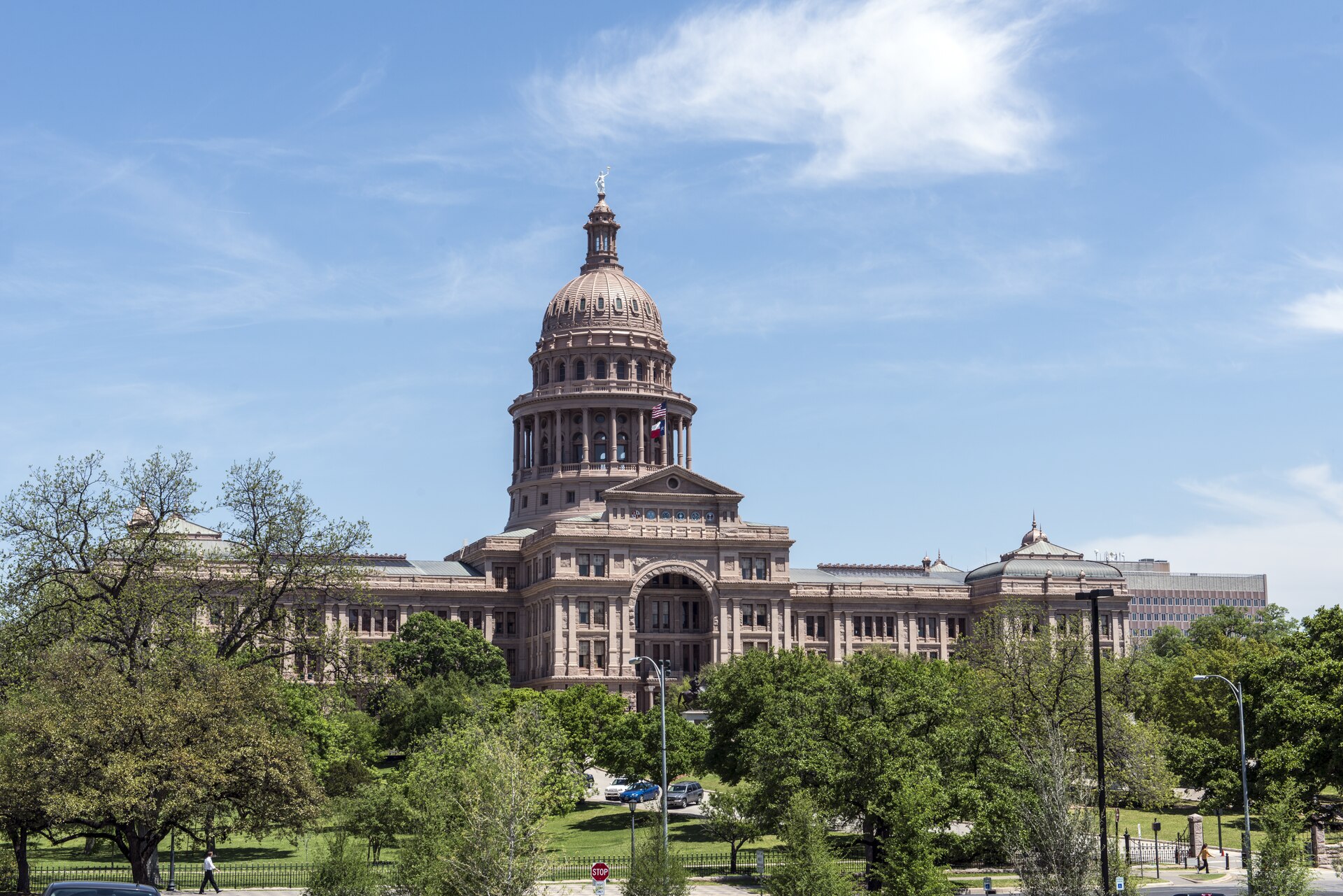
The Texas Capitol, Austin. Photo: Carol M. Highsmith, Library of Congress, via Wikimedia Commons, public domain.
Quick Answer: Texas added 30,600 nonfarm jobs in October 2026, lifting total employment to a record 14,500,500, according to the Texas Workforce Commission. Over 12 months the state gained 203,300 jobs, the most of any state, for 1.4 percent growth. The seasonally adjusted unemployment rate held at 4.4 percent.
How many jobs did Texas add in October 2026?
The Texas Workforce Commission (TWC) reported on Nov. 20, 2026, that Texas employers added 30,600 nonfarm positions in October, bringing the statewide total to 14,500,500 jobs on a seasonally adjusted basis. The October gain followed a September in which the state shed 11,100 positions, according to TWC’s prior monthly release.
Over the year, Texas added 203,300 jobs, an annual growth rate of 1.4 percent. TWC said that pace beat the national rate by 0.8 percentage points. The same day, Governor Greg Abbott’s office said Texas led all states in job gains over the last 12 months and set new records for both total nonfarm jobs and total labor force.
What happened to unemployment and the labor force?
The state’s civilian labor force reached 15,964,900 after adding 16,600 people in October, a record according to the governor’s office. Texans working, including the self-employed, totaled 15,264,500. The seasonally adjusted unemployment rate was unchanged at 4.4 percent.
Which Texas industries added the most jobs?
Professional and Business Services led the private sector, adding 13,600 jobs in October. That raised the industry’s annual growth rate to 4.5 percent, the highest of any private industry in Texas. Construction added 6,900 jobs over the month, and Trade, Transportation and Utilities added 6,100.
Not every sector grew. Information employment was down 10,100 jobs, or 4.6 percent, from a year earlier. Government employment slipped 700 in the month and 2,600 over the year, while Mining and Logging lost 1,500 jobs in October even though it remained up 2,300 from October 2025.
| Industry (seasonally adjusted) | Oct 2026 jobs | Monthly change | Annual change | Annual % |
|---|---|---|---|---|
| Total nonagricultural | 14,500,500 | +30,600 | +203,300 | 1.4% |
| Total private | 12,370,800 | +31,300 | +205,900 | 1.7% |
| Professional and business services | 2,208,300 | +13,600 | +95,400 | 4.5% |
| Construction | 930,500 | +6,900 | +26,900 | 3.0% |
| Trade, transportation and utilities | 2,821,100 | +6,100 | +40,500 | 1.5% |
| Manufacturing | 995,000 | +5,200 | +14,000 | 1.4% |
| Leisure and hospitality | 1,556,000 | +1,700 | +23,900 | 1.6% |
| Private education and health services | 2,004,700 | +800 | +14,400 | 0.7% |
| Mining and logging | 211,500 | -1,500 | +2,300 | 1.1% |
| Financial activities | 941,000 | -400 | +700 | 0.1% |
| Information | 211,400 | -100 | -10,100 | -4.6% |
| Government | 2,129,700 | -700 | -2,600 | -0.1% |
Source: Texas Workforce Commission, produced with the U.S. Bureau of Labor Statistics. Estimates are subject to revision.
Why do goods-producing jobs matter in this report?
Goods-producing industries, which include construction, manufacturing and mining, added 10,600 jobs in October and are up 43,200, or 2.1 percent, over the year. That is faster than the 1.3 percent annual growth in service-providing industries, a sign that building and factory work are carrying a meaningful share of the state’s expansion.
Which Texas metro areas have the lowest unemployment?
The Midland metropolitan area posted the state’s lowest unemployment rate in October at 3.2 percent, not seasonally adjusted. San Angelo followed at 3.5 percent, and Abilene, Amarillo and College Station-Bryan each registered 3.6 percent. The highest rates were concentrated along the border and in parts of the Rio Grande Valley.
| Metro area (not seasonally adjusted) | Oct 2026 rate | Sep 2026 rate | Labor force (thousands) |
|---|---|---|---|
| Midland | 3.2% | 3.2% | 108.7 |
| San Angelo | 3.5% | 3.5% | 62.4 |
| Austin-Round Rock-San Marcos | 3.7% | 3.7% | 1,577.3 |
| Dallas-Fort Worth-Arlington | 4.1% | 4.1% | 4,628.9 |
| San Antonio-New Braunfels | 4.3% | 4.3% | 1,358.9 |
| El Paso | 4.3% | 4.3% | 425.1 |
| Houston-Pasadena-The Woodlands | 4.6% | 4.6% | 3,926.3 |
| McAllen-Edinburg-Mission | 5.4% | 5.6% | 405.4 |
| Brownsville-Harlingen | 5.8% | 5.9% | 187.5 |
| Eagle Pass | 6.4% | 6.2% | 24.5 |
| Texas (statewide) | 4.3% | 4.3% | 16,017.6 |
| United States | 3.9% | 4.0% | 170,906.0 |
The largest metros were steady. Dallas-Fort Worth-Arlington held at 4.1 percent and Houston-Pasadena-The Woodlands at 4.6 percent, while Austin-Round Rock-San Marcos stayed at 3.7 percent. Tyler showed one of the larger monthly moves, rising from 4.0 percent in September to 4.5 percent in October.
How does October compare with earlier in 2026?
The annual pace has picked up since summer. When July data came out in August, the governor’s office reported a 12-month gain of 165,600 jobs and annual growth of 1.2 percent, with nonfarm employment at 14,468,000. By October, the 12-month gain had reached 203,300 and the growth rate 1.4 percent. September was the exception: TWC’s Oct. 16 release initially put total nonfarm jobs at 14,461,300 after the state shed 11,100 positions that month. The latest release revises September to 14,469,900, and October’s gain more than made up the ground lost. As always, TWC notes that all of these estimates are subject to revision.
What did state officials say about the numbers?
TWC Chairman Joe Esparza credited Texas employers for the monthly gain and pointed to the agency’s Skills Development Fund grants and Skills for Small Business program as ways TWC is helping employers train workers. Commissioner Representing Labor Alberto Treviño III highlighted a civilian labor force approaching 16 million, and Commissioner Representing the Public Brent Connett pointed to TWC’s career and technical education town halls and Jobs and Education for Texans (JET) grants.
The governor’s office said Texas has gained nearly 2.7 million jobs since January 2015, more than any other state over that period.
Brian’s Take
What stands out to me is where the growth is coming from. Professional and business services alone accounted for nearly half of the state’s 203,300 jobs added over the past year, and construction grew at 3 percent. Those are the jobs that follow corporate relocations, new plants and data centers, and they say Texas is still adding the white-collar and building capacity that big projects need.
The softer spots deserve attention, too. Information jobs are down 4.6 percent over the year, government employment is flat to slightly down, and unemployment in the border metros runs well above the statewide rate, with Eagle Pass at 6.4 percent and Brownsville-Harlingen at 5.8 percent. A record labor force with an unemployment rate stuck at 4.4 percent tells me new workers are being absorbed, not that the labor market is getting tighter. For employers, that is a reason to keep using the training programs TWC is promoting rather than assume the hiring pool will dry up.
Frequently Asked Questions
How many jobs does Texas have now?
Texas had 14,500,500 seasonally adjusted nonfarm jobs in October 2026, a record according to the governor’s office.
What is the Texas unemployment rate?
The seasonally adjusted rate was 4.4 percent in October 2026, unchanged from September.
Which industry grew fastest in Texas over the past year?
Professional and Business Services, with 4.5 percent annual growth, the highest among private industries.
Which Texas metro had the lowest unemployment?
Midland, at 3.2 percent not seasonally adjusted.
When is the next Texas jobs report?
TWC scheduled November data for release on Friday, Dec. 18, 2026, at 9 a.m. Central.
Sources and Further Reading
- Texas Gains More Than 30,000 Nonfarm Jobs in October, Texas Workforce Commission
- Texas Leads All States For Annual Job Gains (November and August 2026 releases), Office of the Texas Governor
- Texas Annual Growth Rate Outpaces Nation as Labor Force Adds 15,800, Texas Workforce Commission